Alex
Alex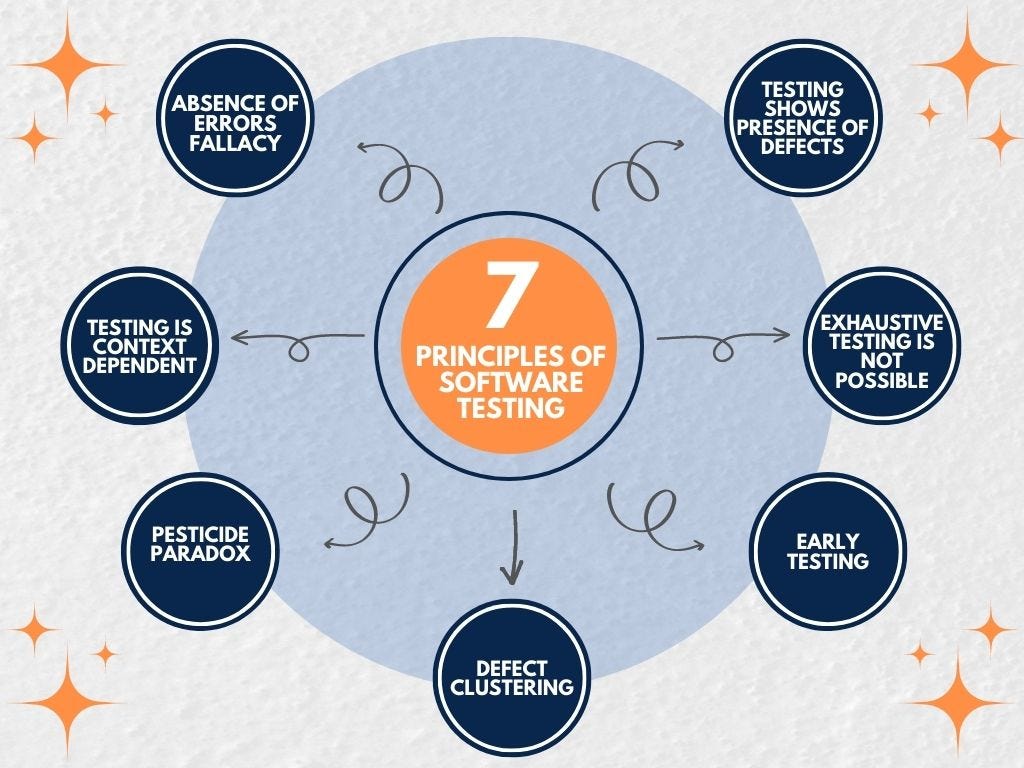
Think of software testing as preparing a spacecraft for launch. Every nut, bolt, and circuit must be checked before ignition because even the most minor flaw could spell disaster once the rocket leaves Earth. In this metaphor, testers are mission engineers, working tirelessly to uncover hidden cracks before they expand into catastrophic failures. Their mindset isn’t about finding perfection but ensuring reliability under the harshest conditions. The “seven principles of software testing” are the guiding stars in this mission, shaping how testers think, act, and protect digital products from imploding mid-flight.
Principle 1: Testing Shows Presence, Not Absence
Testing is like shining a torch into a dark cave. You illuminate parts of the cavern and discover bats or hidden treasures, but you can never claim the cave is empty. Similarly, testers can reveal defects but cannot guarantee absolute flawlessness. This principle humbles even the most experienced professionals: no matter how thorough, testing only reduces risk—it never eliminates it. Learners in a Software Testing course soon grasp this idea, realising that their role is to provide insight and assurance, not an unattainable promise of perfection.
Principle 2: Exhaustive Testing Is Impossible
Imagine trying to taste every grain of rice in a pot to confirm it’s cooked. It’s absurdly impractical. Instead, you sample strategically to judge the whole. Exhaustive testing follows the same logic—you cannot test every possible input, path, or condition. The art lies in selecting representative cases that reveal the maximum amount of information with the minimum effort. Experienced testers build test suites like chefs sampling carefully, confident that a well-chosen spoonful can speak for the entire meal.
Principle 3: Early Testing Saves Time and Cost
Consider building a house. Spotting a faulty foundation after the roof is in place demands costly reconstruction, while identifying the flaw at the blueprint stage saves both time and money. Software testing follows this principle: defects discovered early in requirements or design are far cheaper to fix than those found after deployment. Courses and training environments emphasise this because it shapes the tester’s instinct to scrutinise early artefacts—documents, models, and initial code—long before the product reaches the customer.
Principle 4: Defect Clustering
In every orchard, a handful of trees often bear the most fruit. Likewise, in software, a small number of modules typically harbour most of the bugs. This phenomenon is called defect clustering. It encourages testers to focus their energy where vulnerabilities are most likely to concentrate, much like a gardener pruning the densest branches first. Students encountering this idea in a Software Testing course begin to understand why prioritisation matters—resources should flow to where risk is greatest, not spread evenly across the entire landscape.
Principle 5: The Pesticide Paradox
Farmers know that spraying the same pesticide repeatedly eventually makes pests resistant. In testing, running the same test cases over and over breeds complacency; bugs adapt, and new defects sneak past undetected. This is why testers constantly refresh their approach, designing new test cases and strategies to outwit evolving threats. The pesticide paradox reminds testers to innovate, keeping their thinking sharp and their eyes fresh. Like a farmer rotating crops, a tester’s creativity keeps the ecosystem resilient.
Principle 6: Testing Is Context Dependent
Testing a pacemaker is not the same as testing a video game. Both are software, but the stakes, methods, and criteria differ dramatically. This principle highlights that context dictates strategy. Safety-critical systems demand rigorous verification, whereas entertainment products may prioritise usability and performance. A tester’s mindset must be adaptive, shifting seamlessly depending on the product’s purpose. Recognising this prepares professionals to be versatile, ensuring that their skills transfer across industries without losing relevance.
Principle 7: Absence-of-Errors Fallacy
Imagine a beautifully polished boat with no leaks—but it was designed for a lake and is now expected to sail the ocean. Even if flawlessly built, it will fail because it wasn’t the right vessel for the task. Similarly, software without defects is useless if it doesn’t meet business or user needs. The absence-of-errors fallacy teaches testers that success isn’t defined solely by bug counts but by alignment with purpose. A product can be technically flawless yet practically worthless if it misses its audience’s expectations.
Living the Principles: A Tester’s Mindset
The seven principles aren’t abstract rules; they form the heartbeat of a tester’s daily work. Each one reinforces humility, strategy, creativity, adaptability, and a sense of purpose. Together, they create a mindset that views testing as both science and art—a discipline where sharp logic meets imaginative problem-solving. They remind testers that their job is not to guarantee perfection but to deliver confidence and clarity in uncertain environments.
Conclusion
Software testing is less about bug hunting and more about risk navigation. Like engineers safeguarding a rocket launch, testers follow guiding principles that shape their actions and sharpen their instincts. The seven principles of software testing serve as a compass, ensuring that they never lose sight of their mission: delivering reliable, relevant, and resilient software. For newcomers stepping into this world, embracing these ideas early is invaluable. They transform testing from a mechanical activity into a mindset, preparing testers to contribute meaningfully in every project they touch.